More than 150 part-time master’s students at FHWien der WKW were surveyed as part of a study on performance motivation, organizational commitment, and the importance of various professional aspects.
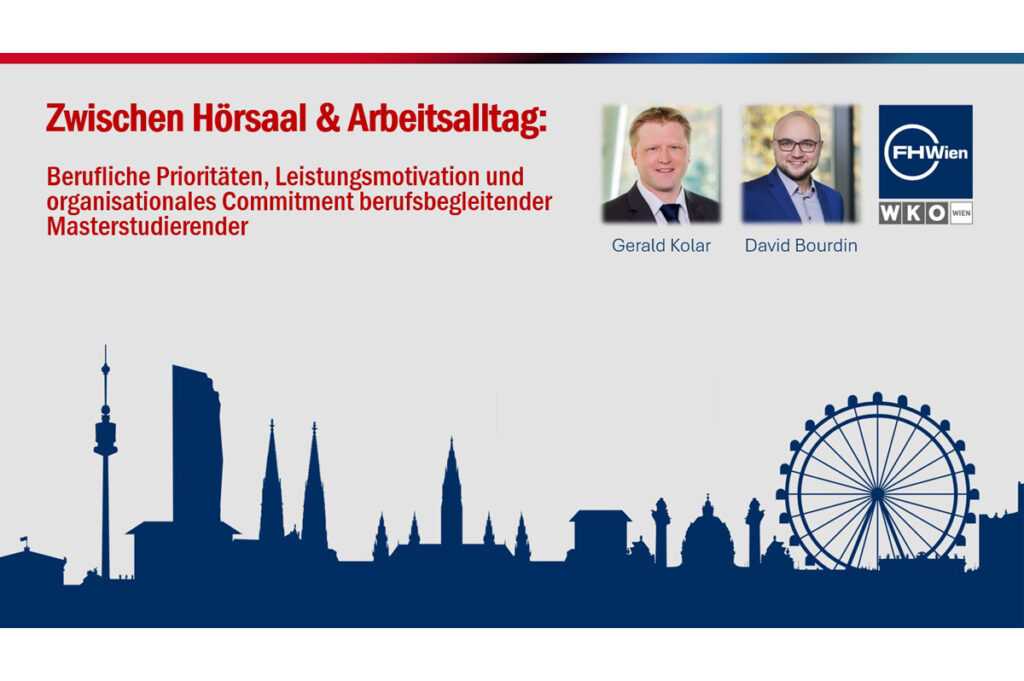
Working while studying is no longer the exception. At FHWien der WKW, about two-thirds of students are working while they study. How do working students manage the balancing act between the lectures and their daily work life? This is the question posed by David Bourdin, Senior Researcher at the Competence Center for Marketing at FHWien der WKW, and Gerald Kolar, Head of the Competence Center for Leadership & Social Skills. In an online survey, they sought to determine what professional priorities part-time master’s students set, where they draw their motivation to perform, and how strong their commitment to their employers is.
A positive work environment is essential
The study of professional priorities clearly shows that a positive work environment, good earning potential, and interesting career advancement opportunities are the most important factors, while benefits in kind and flat hierarchies are secondary considerations. A cluster analysis identified three distinct preference profiles: the pragmatists, the career-oriented individuals, and those focused on work-life balance and the work environment.
Pride in one’s achievements motivates perseverance
Pride in one’s own achievements plays a central role. Being able to manage a dual workload provides the emotional motivation to persevere. Part-time students are also characterized by a certain degree of persistence. Rather than seeking out challenges, they focus on the efficient use of resources. The need for variety and new experiences ranks third among motivational factors. It is therefore not surprising that they also change jobs more frequently.
Loyalty to employers is low
According to the study’s findings, frequent job changes result not only from sensation seeking but can also be attributed to a generally low level of organizational commitment. Part-time master’s students do not feel emotionally or rationally committed. Normative commitment—that is, the sense of a moral or obligatory bond—is particularly low. Overall, commitment therefore arises less from a sense of moral duty or loyalty and more from a good current fit, a culture that values performance, and visible opportunities for development.
The analyses also clearly show variations based on gender, age, employment status, length of service, and managerial responsibilities.
The bottom line:
- Gen Z young professionals are not a homogeneous target group. Employer branding, as well as talent development and retention strategies, require differentiated, segmented approaches.
- Working students are ambitious and resilient, but their dual roles mean they are constantly operating near their breaking point. Universities and organizations share responsibility for creating conditions that enable predictability, flexibility, and realistic expectations.
David Bourdin presented the results of the study at the 19th Research Forum of Austrian Universities of Applied Sciences in April 2026.