Cornelia Dlabaja, Endowed Professor of Sustainable Urban and Tourism Development at FHWien der WKW, examines how mass tourism is affecting Venice’s public infrastructure. In an article in the “International Journal of Urban and Regional Research,” she highlights how local initiatives are attempting to preserve social cohesion and the “right to the city” in an increasingly commercialized environment.
Venice is considered a symbol of overtourism and exemplifies the challenges facing historic cities. In the “International Journal of Urban and Regional Research”, Cornelia Dlabaja analyzes how mass tourism and commercialization are transforming and, in some cases, displacing key public infrastructure in the lagoon city.
Public Spaces Under Growing Pressure
This study focuses on the interplay of developments at various levels. In everyday life, for example, this transformation is evident in a lack of seating or overcrowded public spaces that are barely tailored to the needs of the local population. At the neighborhood level, this affects facilities such as schools or shops for daily necessities, the decline of which makes daily life more difficult for residents. For example, the closure of schools leads to families moving away. At the citywide level, political decisions and economic interests have an impact, for example in the form of cruise tourism, which places a strain on both the environment and the urban infrastructure.
The consequences are profound: the population has declined sharply, while tourism-related uses dominate. Housing is increasingly being used for short-term rentals, local shops are disappearing and being replaced by tourist-oriented businesses. Venice is in danger of losing its function as a living space and becoming a mere “backdrop.”
The City Between Liveability and Tourism
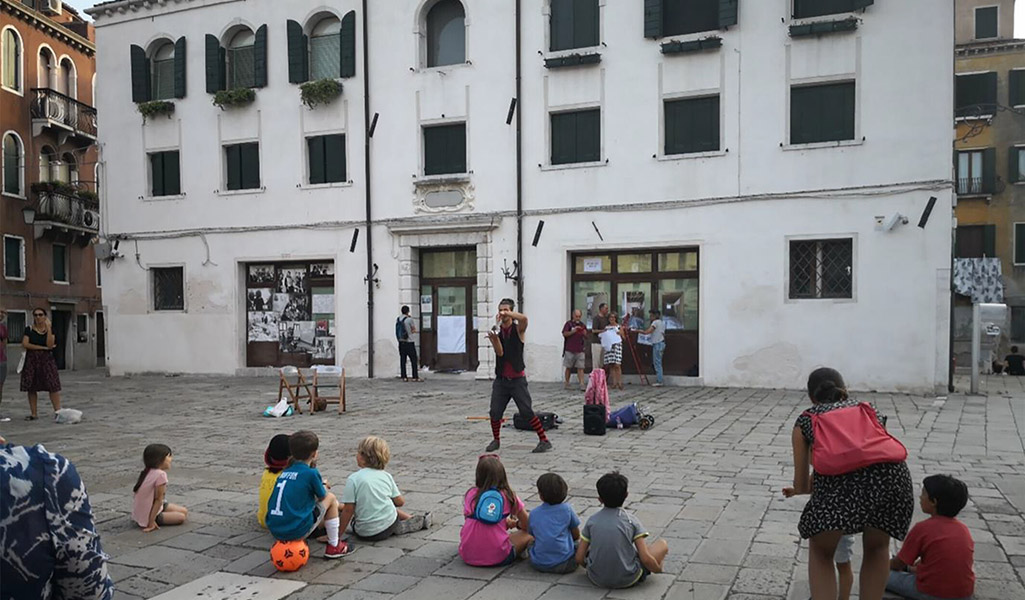
At the same time, however, Dlabaja’s research also highlights counter-movements. Local initiatives such as the “Vida Movement” or the “Comitato No Grandi Navi” are actively campaigning to preserve communal spaces. They organize protests, neighborhood activities and alternative uses of public spaces. The author views these practices as forms of collective “care” aimed at preserving the city as a common good.
The study makes it clear that Venice’s future depends significantly on how public infrastructure is protected and reimagined, and on the role civil society engagement plays in this process. As an urban living space and tourism hotspot, Vienna also stands to benefit from this. As an endowed professor for sustainable urban and tourism development, Cornelia Dlabaja provides academic support for Vienna’s Visitor Economy Strategy. Particularly in the context of placemaking, she examines how tourism and urban planning can work together to create new urban spaces that appeal to both the local population and visitors alike. At the end of 2025, twelve concrete principles were published as a guide titled “The Places To Be”.
>> To the open-access article in the International Journal of Urban and Regional Research
>> To the website of the Endowed Chair for Sustainable Urban and Tourism Development