Communication research at FHWien der WKW highlights how algorithmic platforms are reshaping public debates, why trust in the media remains crucial, and what risks fragmented information spaces pose to social cohesion.
For many young adults today, social media is a primary source of news. At the same time, journalism remains essential when it comes to contextualizing and verifying information. However, as the role of algorithm-driven platforms grows, so does the concern that public debates are becoming increasingly fragmented.
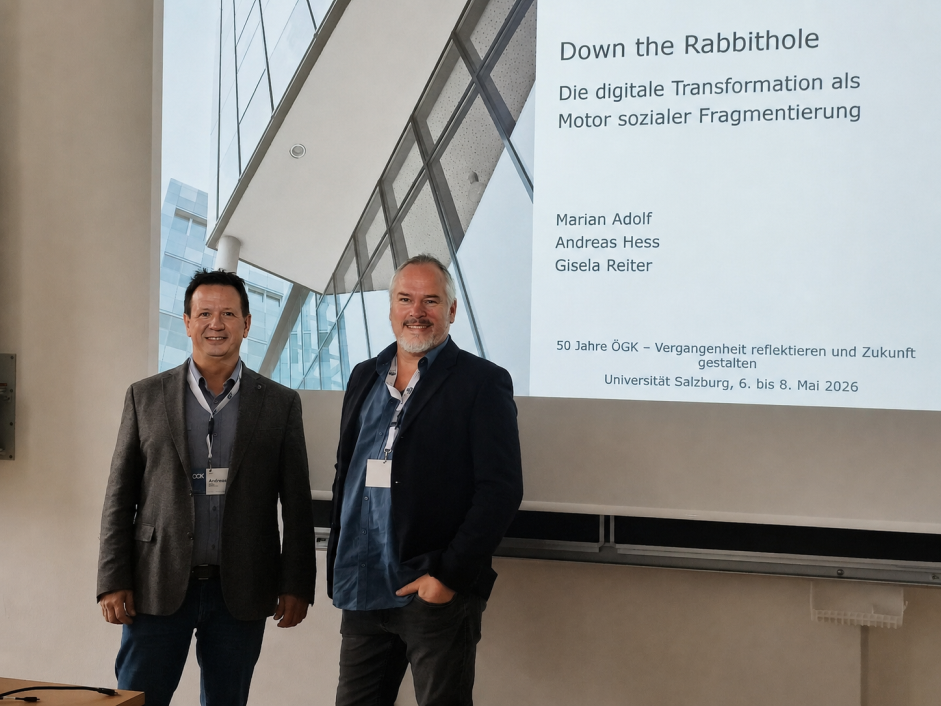
The talk “Down the Rabbit Hole: Digital Transformation as a Driver of Social Fragmentation,” presented by Marian Adolf, Andreas Hess, and Gisela Reiter—researchers at the Department of Communication at FHWien der WKW—addressed these developments in a rapidly changing media landscape as part of the anniversary conference of the Austrian Society for Communication Studies (Österreichischen Gesellschaft für Kommunikationswissenschaft) at the University of Salzburg.
Social media as a gateway to current topics
The results paint a nuanced picture: Social media often serves as a quick start to current topics. However, many respondents continue to turn to journalistic sources for more in-depth information. Social media thus acts as a gateway, while journalism serves as a source of context and verification.
Influencers are viewed with mixed feelings. While their accessible language and relatability are appreciated, there are also doubts about the quality of their research, their objectivity, and their reliability. Journalism is not being replaced, but must reposition itself in a changing information landscape. Trust remains a key factor in this context. Established media brands and public broadcasting services are still generally considered reliable.
Personalized media consumption is fragmenting society
Yet increasingly individualized media consumption also carries the risk of fragmentation: Do we as a society still share the same issues, do we still refer to the same information, and do we still speak the same language? Biased algorithms, special interests, and changing information and consumption behaviors (such as the growing tendency to avoid the news) are leading to a decline in social and cultural points of reference. Yet these are essential for a shared public sphere as the foundation of social understanding—and therefore require our protection!