Maija Worek from the Management & Entrepreneurship Study Programs received the EQUA Foundation’s Best Paper Award at the 15th Conference of German-Speaking Research Centers and Institutes for Family Businesses (FIFU) at MCI Innsbruck.
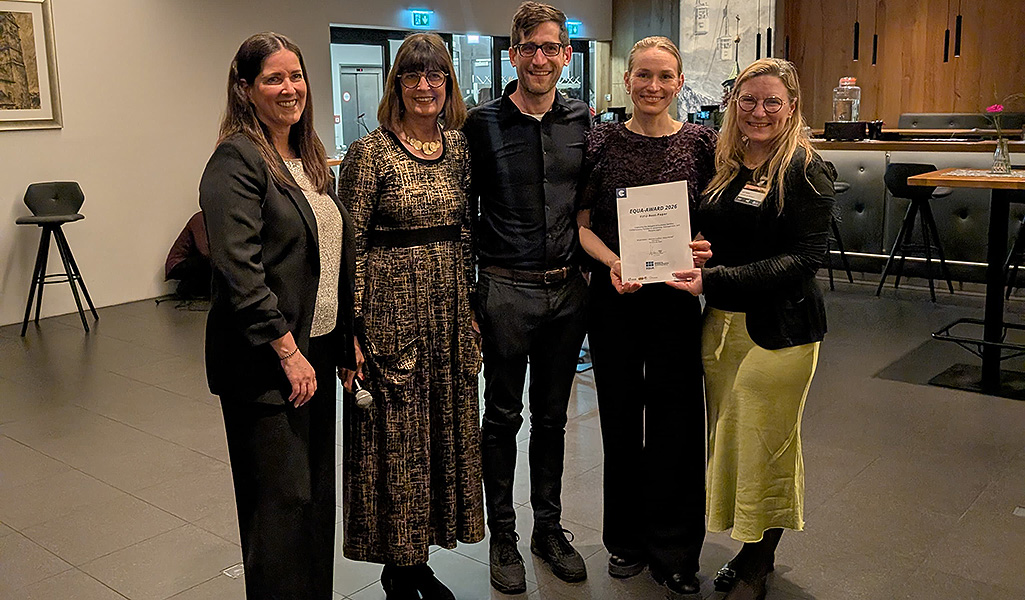
In the award-winning paper, the researcher explores, together with Birgit Felden and Michael Graffius from the Berlin School of Economics and Law, why classical research models and traditional assumptions no longer do justice to the realities of entrepreneurial families today. Although family businesses are considered stable pillars of the economy, a closer look reveals that the underlying family structures are increasingly changing. Traditional assumptions, particularly those regarding a clearly defined core family, often fall short today and no longer reflect the current zeitgeist.
Diversity as a new reality
Contemporary entrepreneurial families have become more diverse – in terms of their lifestyles, relationships and division of roles – such as blended, adoptive, rainbow or multi-parent families.These developments influence not only the question of who holds ownership or assumes leadership roles, but also the evolution of family businesses across generations. As a result, both static aspects such as ownership distribution and dynamic processes such as business succession and life cycles are undergoing change.
However, existing research on family businesses often continues to focus on traditional family models. To address this discrepancy, the present approach combines insights from family research, entrepreneurship and research on family businesses. The goal is to further develop existing models and adapt them to today’s reality.
New perspectives on existing concepts
The results demonstrate specifically how established models can be adapted: The three-circle model, which describes the interplay between family, property and business, as well as the life-cycle model, which explains the development of family businesses across various phases, are expanded by two additional levels: a contemporary perspective that reflects current developments, as well as an outside perspective that highlights new forms of coexistence.
These extensions preserve the strengths of the classical models while simultaneously creating a more realistic foundation for analysis and research. At the same time, they open up new paths for future studies, particularly through multi-stage research designs that also account for nonlinear developments in family businesses. This makes it clear: Anyone who wants to understand family businesses must rethink the conventional image of contemporary families.
New role models and digital influences on the next generation
In addition, another study presented by Maija Worek in Innsbruck – published in collaboration with Johanna Heisgen and Michael Graffius (both from HWR Berlin) – shows that the family’s role as a business role model within the company is changing for the next generation. The results illustrate that the next generation in family businesses perceives influencers as relevant entrepreneurial role models. Significant differences emerge when compared to individuals without this specific entrepreneurial background: For many of these young people, influencers shape not only their attitudes but also their entrepreneurial mindset. This expands the understanding of socialization in family businesses to include a digital dimension that should be given greater consideration in the future.