Innovation through Cooperation in Education - Creating New Opportunities for Students
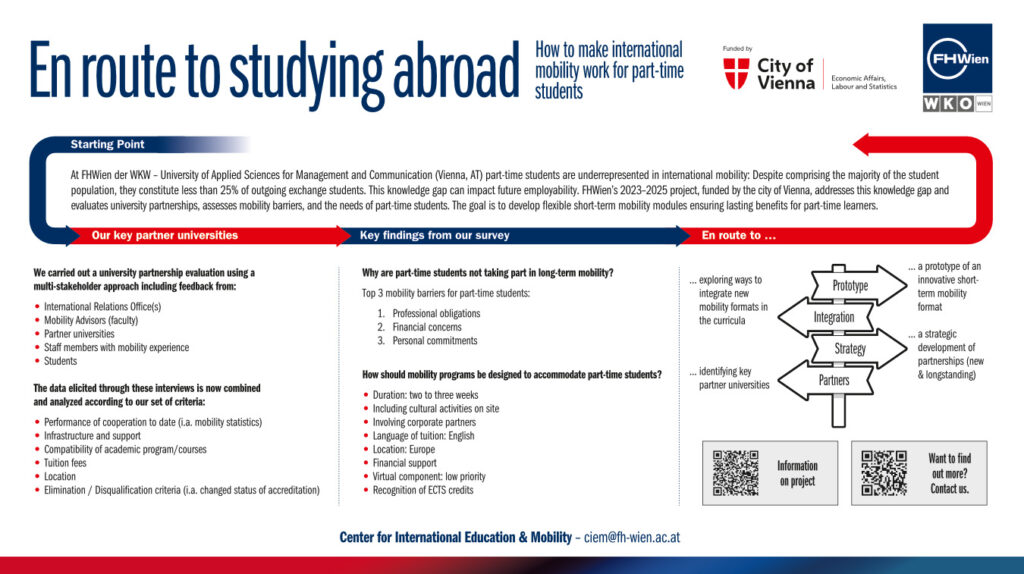
Study-relevant periods abroad are the best way for students to acquire international competencies. While part-time students make up the majority of the student body at FHWien der WKW, they participate only marginally in international mobility programs. How can international experiences be made accessible to part-time students as well?
The goal of the project, funded by the City of Vienna, was to develop innovative and flexible mobility programs and to further strengthen the long-term collaboration with FHWien der WKW’s international partner universities.
Funding: City of Vienna (MA23 – Economy, Labor and Statistics)
Project period: 01.01.2023 until 30.06.2026
Project duration: 42 months
Project Description
The project was based on the observation that part-time students rarely take advantage of study-relevant stays abroad.
Cooperation as the key to success in international activities
Another focus was on the strategic development of FHWien der WKW’s international partner network. Although this network had grown steadily in recent years, cooperation was often limited to individual activities such as student exchanges.
Project Results
As a result of the project, an example of good practice is available that can be included as a mobility format in the curricula of part-time degree programs. After an evaluation and classification of the university partnerships, FHWien der WKW should have the best possible network of partner universities for sustainable cooperation.
Innovative Mobility Model
Based on the findings, the project developed an innovative mobility model for shorter study abroad experiences that combines hybrid teaching and learning formats with collaboration between companies and universities. The prototype was successfully tested in the Digital Business (BA) and Marketing and Sales Management (MA) degree programs.
Examples of Good Practice
The examples of good practice that emerged from the prototype provide a foundation for permanently integrating new mobility formats into the curricula of part-time degree programs in the future. The degree programs are also provided with guidelines for successfully implementing short-term mobility.
Quality Assurance of Partnerships
Through systematic evaluation and classification of the collaborations, the quality of the partnerships was ensured, particularly high-performing partner universities were identified, and measures for monitoring and further developing the partnerships were defined in a “roadmap.”
Additional Spin-off Initiatives
Beyond the immediate project results, several valuable spin-off initiatives emerged. These include a concept for digitizing the process of establishing partnerships, as well as the “Off the Beaten Track” initiative, which draws students’ attention to attractive, lesser-known destinations abroad, thereby opening new perspectives for international experiences.
Through EDUcation-INNOvation-COOPeration, FHWien der WKW is making an important contribution to the further development of internationalization in higher education. The project demonstrates how digital innovations, strategic partnerships, and mobility programs tailored to specific target groups can make international education sustainably accessible, even for students pursuing their studies while working.