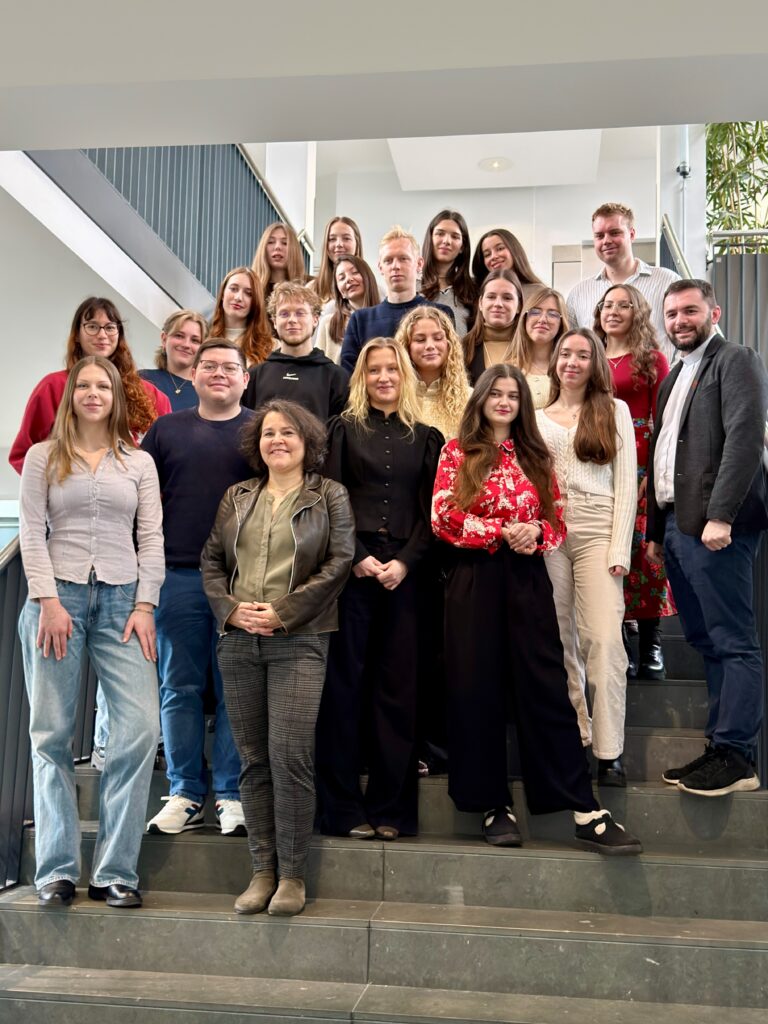
From February 9 to 13, 2026, the first of two project weeks for the International School of Multimedia Journalism (ISMJ) 2026 took place in Vienna. Students from FHWien der WKW collaborated with participants from Ukraine and Denmark to produce multimedia reports on war and crisis reporting in the digital space. The second project week will take place in Warsaw in early July.
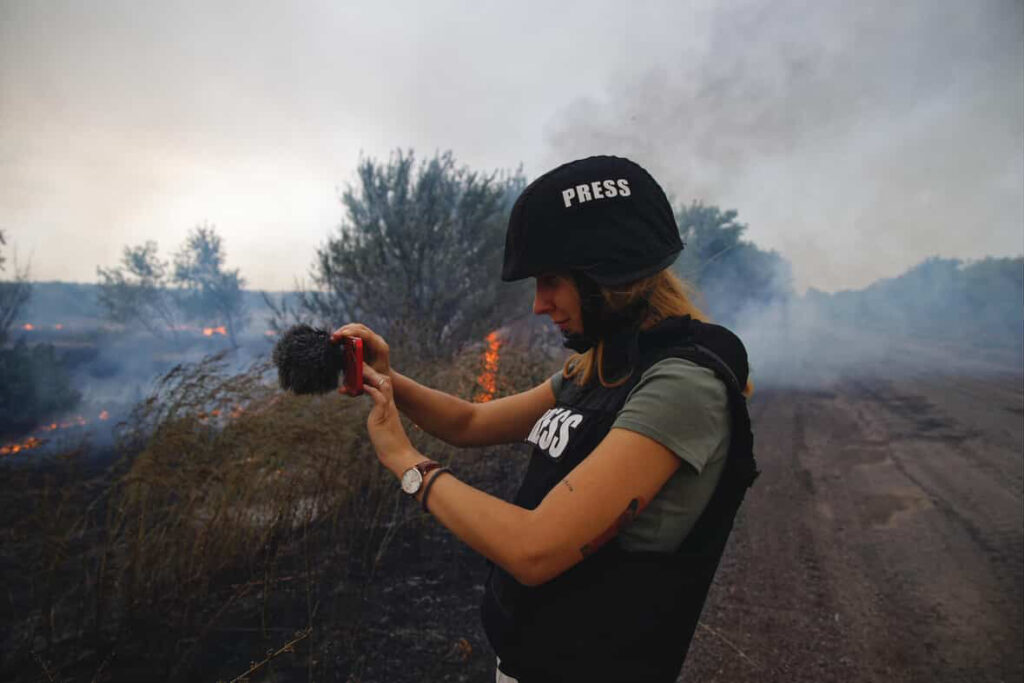
How can a video from a war zone be verified? How can journalists recognise manipulated content on social networks? And how can reporting on violence and suffering be done in a way that informs without overwhelming?
These questions kicked off the International School of Multimedia Journalism (ISMJ) 2026 under the theme ‘Reporting Wars – From the Frontline to the Timeline’.
The war in the news feed
War and crisis journalism has changed fundamentally. Information circulates in real time, images spread virally, narratives are amplified algorithmically. First impressions often arise in social media timelines before traditional media can classify them. This increases the responsibility of journalistic work: verification, contextualisation and ethical consideration are among the key competencies in the digital age.
In internationally mixed teams, participants discussed the challenges media professionals face when dealing with information, trauma, propaganda and the rapid speed of news flow. They also examined the role digital formats play in documenting events and shaping social memory.
Research and verification in practice
The project week began with a masterclass on disinformation and verification. Eva Wackenreuther, from the ORF fact-checking team, explained to participants how various methods of disinformation work, and how they can be verified. Particular attention was paid to how false reports arise on Telegram and how students can conduct their own research on the platform.
Through practical exercises, participants learned digital research methods, reconstructed image contexts, and discussed which information is reliable and where uncertainties remain. The masterclass concluded with insights into OSINT techniques, demonstrating how geolocation is employed in verification and emphasising the importance of social media monitoring for verification journalists.
As a journalist in a war zone
A second masterclass complemented the digital perspective by drawing on practical experience from the field. Aleksandra Tulej, deputy editor-in-chief of the Wiener Zeitung, shared her insights on working methods, decision-making processes, and the challenges involved in reporting from crisis areas. She explained how journalists prepare for reporting from crisis areas, which organisational and safety-related aspects need to be clarified in advance, and where improvisation is unavoidable. This involved answering very specific questions: What should be packed? What risks need to be taken into account? And how should journalists react when a situation escalates?
Multimedia projects and intercultural exchange
Intercultural exchange is an integral part of the ISMJ experience: students from a variety of countries and cultures learn from each other, developing their intercultural skills in the process. The focus is also on practical learning, with research, interviewing, videography and digital storytelling forming integral parts of the programme. Over the course of a week, teams develop independent stories, design storyboards, conduct interviews and produce multimedia content. Joint dinners and cultural activities in Vienna provide opportunities for informal networking and exchange.
Several multimedia features were created as part of the thematic focus on ‘Reporting Wars’.
War in your feed“The first casualty when war comes is truth,” a saying commonly attributed to U.S. politician Hiram Johnson, is more relevant today than ever. Through social media platforms, misinformation, disinformation, and propaganda spread at unprecedented speed. What once took days or weeks to circulate can now reach millions within minutes. Those who control the narrative can shape the course of a conflict. What can be done to safeguard the truth? Multimedia feature from Yaryna Danyliak, Gustav S. Frisch, Sofiia Koshova, Valentina Perner and Alina Smyk. |
Storyshelling: People who risk their lives to give others a voice2025 was one of the deadliest years for war journalists. Nevertheless, they continue to travel to crisis and conflict zones to document the suffering caused by war. Who are these journalists? Why do they put their lives at risk? We asked them. Multimedia feature from Zoriana Katola, Solomiia Stanovych, Renja Natalia Prechtl, Signe Nielsen and Christoph Bosnjak. |
Information BlackoutWhen power and internet access disappear, journalists on the frontline lose the tools needed to verify, report, and share critical information. From the war in Ukraine to other conflict zones, information blackouts have become a strategic weapon that restricts reporting. This raises urgent questions about how journalism can function when the flow of reliable information is cut off. Multimedia feature from Anna Pedersen, Iwan Kasprzyk, Yuliia Musianovych, Oleksandra Zharska and Tamila Koval. |
The female fight for the frontlineWhat does the everyday work look like as a female war and crisis reporter? What challenges do you have to conquer on the frontline? Who were the women who paved the way and who are the women still changing the narrative of female war reporters? From Alice Schalek to Aleksandra Tulej, from covering world wars to working in modern day conflicts in Syria, the Middle East and Ukraine. To find answers to these questions we talked to different female war and crisis reporters and listened to stories about their realities. Multimedia feature from Aviana Horvath, Elsa Mayringer, Solomiia Bodnarchuk, Sofiia Dubik and Marcus Norup Refsgaard. |
Conclusion and outlook
During the project week in Vienna, the importance of fundamental journalistic principles such as research, verification and ethical reflection in crisis reporting was demonstrated. Participants had the opportunity to develop their journalistic skills, forge international friendships and enhance their understanding of media ethics issues – invaluable experiences that will broaden their horizons as young journalists.
As in previous years, the International School of Multimedia Journalism (ISMJ) will comprise two project phases in 2026: the first will take place in Vienna, followed by a second project week in Warsaw in July. With the support of the participating institutions and partners, the ISMJ’s goal remains unchanged: to equip young journalists with the practical skills and intercultural understanding needed to strengthen independent journalism in Europe.

About the International School of Multimedia JournalismThe ISMJ was established after the annexation of Crimea and the start of the Russian-Ukrainian war in 2014. The project is a collaboration between the Journalism & Media Management study programs at FHWien der WKW, the Ukrainian Catholic University of Lviv and the OeAD Cooperation Office in Lviv. It`s aim is to strengthen the connection between the two countries and send a signal of support for Ukraine. Since the second year of its existence, the Danish School of Media and Journalism and the Georgian Institute of Public Affairs have also participated as additional project partners. Further information about the ISMJ can be found on the project website at https://multimediajournalism.eu/.
|
 The project is being carried out with financial support from the Austrian Federal Ministry of Women, Science and Research (BMFWF) and is being realised in cooperation with the OeAD Cooperation Office Lviv, the Ukranian Catholic University and the Austrian Cultural Forum in Warsaw.