Strong interest in the Eurovision Song Contest 2026 was evident at the fourteenth “Public Value Lecture: Media & Democracy”, which attracted numerous students, lecturers, and guests to the Audimax of FHWien der WKW. The guest speaker was Roman Horacek, ORF’s Head of Communications for the Eurovision Song Contest 2026. He offered exclusive insights into the planning of one of the world’s largest media events and explained how ORF, together with its partners, is preparing for the ESC’s return to Austria. The event was held in cooperation with the ORF Public Value Competence Center.
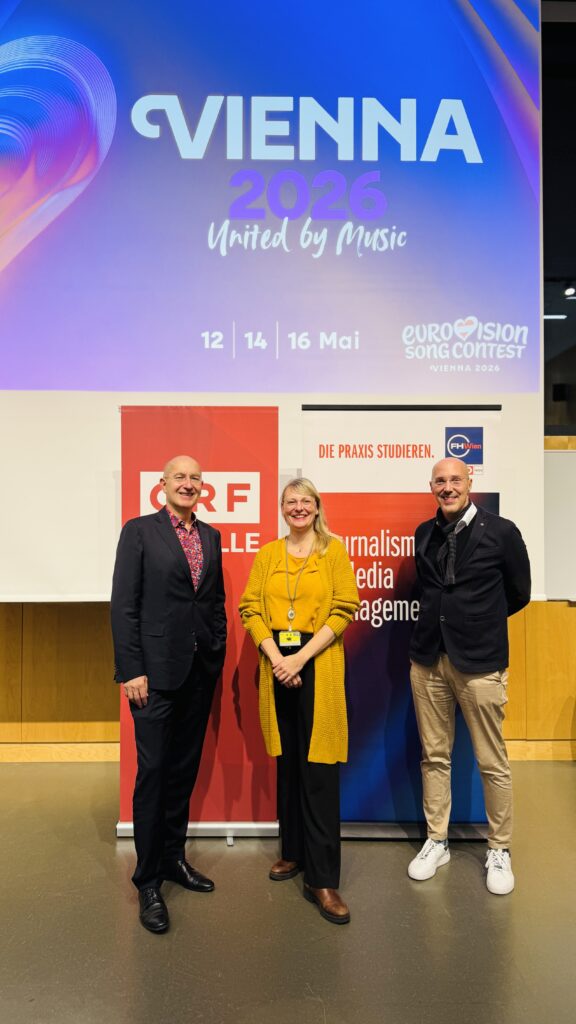
At the beginning, Gisela Reiter, Research & Teaching Associate at FHWien der WKW, welcomed the participants and highlighted the role of Public Value and its importance for our society. Afterwards, Konrad Mitschka from the ORF Public Value Competence Center explained why the Eurovision Song Contest is considered Public Value within ORF’s portfolio and how it fits into the broadcaster’s strategy.
Decades of ESC Experience
Roman Horacek has been part of the Austrian ESC delegation since 2005 and took over communications duties in 2015 – the year of the legendary Song Contest in Vienna – as Head of Press. For the Eurovision Song Contest 2026, which will once again take place in Austria, he is assuming responsibility again as Head of Communications in the ESC core team. In his presentation, he outlined the long-term strategic planning and the extensive preparations required for a global media event.
Topics of the Presentation
In a packed auditorium, Horacek provided a multifaceted overview of the various areas of responsibility within his team. The key topics included:
-
Long-term strategic planning: How is an international competition structured, and what organizational and logistical requirements come with a project like the ESC in Vienna?
-
Media relations and live communication: What special challenges arise when working with international media representatives, and how flexible must a communications team be during live situations?
-
Team coordination: What kind of coordination takes place within ORF and with partners such as the European Broadcasting Union (EBU) and the City of Vienna?
-
Public Value: What significance does an event that reaches millions of people worldwide hold for the public, and what responsibilities does ORF assume in this context?
In addition to an overview of the current preparation status, Horacek also spoke about lessons learned from previous years, creative processes, and the flexibility required in media work.
Lively Discussion and Valuable Insights
The high level of public interest demonstrated how strongly the Eurovision Song Contest fascinates people beyond the stage itself. Practical examples from communication work and vivid stories from the ESC world offered an open look behind the scenes of an event that shapes the international media landscape year after year. Following the lecture, many participants took the opportunity to ask questions and engage in conversation with the expert.
About the Public Value Lecture
The series “Public Value Lecture: Media & Democracy” regularly invites renowned media experts to discuss current developments, challenges, and opportunities in the fields of media and democracy. These events are open to the public and promote exchange between academia, the media industry, and society. With Roman Horacek’s lecture, FHWien der WKW set another important impulse for strengthening media literacy – and already offered a taste of the Eurovision Song Contest 2026 in Vienna.
Further information about ESC 2026 at ORF can be found at https://tv.orf.at/esc26/.