Maija Worek from the Management & Entrepreneurship study programs presented the master’s thesis by FHWien graduate Erica Lubrano at the EGOS Local Hub at WU Vienna. The study shows how small family businesses integrate services into their business models—and what role customer proximity, family, and trust play in this process.
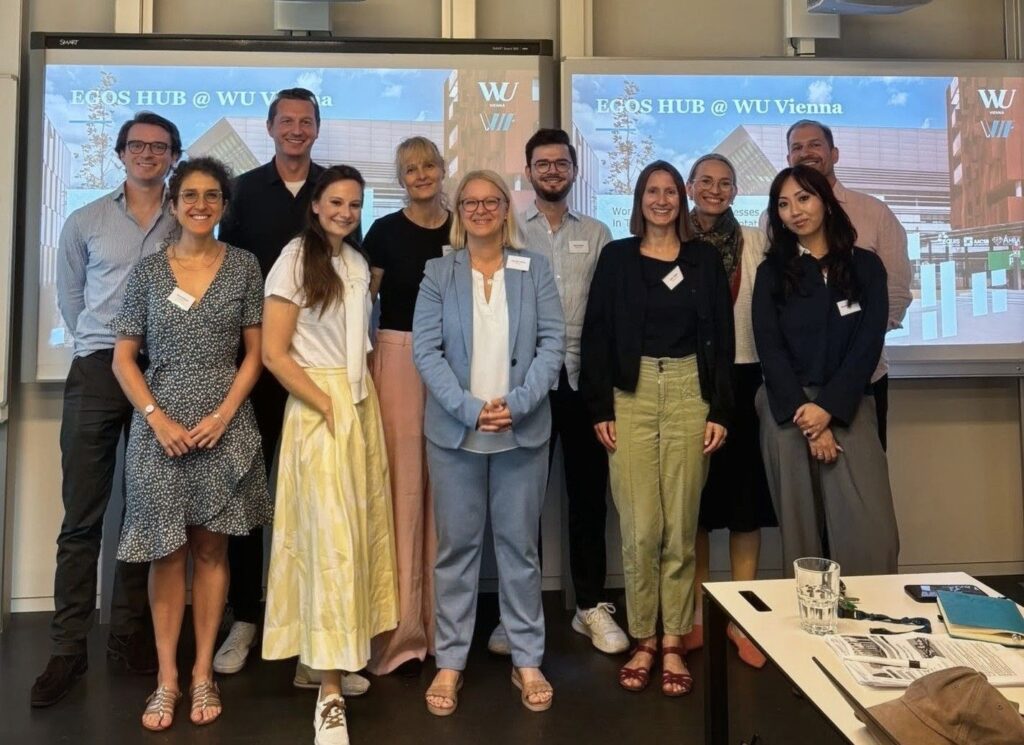
How can small, family-run retail businesses adapt their business models as product margins shrink and customers increasingly expect customized solutions? Erica Lubrano addressed this question in her master’s thesis at FHWien der WKW. Maija Worek presented the findings on July 8, 2026, at the EGOS Colloquium Vienna Hub at the Vienna University of Economics and Business (WU Wien) as part of the thematic track “Family Businesses and Business Families in Times of Crisis, Fragmentation, and Disorder”.
Expanding the Product Line Through Services
The study focuses on “servitization”: companies supplement their product offerings with services such as consulting, repairs, maintenance, customization, or subscription models. Lubrano conducted an empirical study of small family-owned businesses in Austria, Italy, and Germany. The study was based on interviews with members of the owner families who work in the companies.
The results show that in small family-owned businesses, servitization often does not take the form of a large-scale strategic project but rather unfolds gradually and through dialogue with customers. Many services emerge because customers ask questions, need support, or want customized solutions. Additional services that are initially provided free of charge can thus become new sources of revenue.
Customer Focus and Stable Structures Foster Service Innovations
The study identifies customer focus, differentiation from the competition, and financial stability as the most important drivers. Services can help build long-term customer loyalty, tap into new markets, and make revenue less dependent on product sales alone. At the same time, there are hurdles: limited human resources, a lack of expertise, spatial constraints, dependence on external partners, or the challenge of helping customers understand new service offerings.
The role of the family becomes particularly evident. Trust, reputation, and a long-term perspective can become key resources. In many cases, the service is closely linked to the family, its values, and its personal relationship with customers. At the same time, family influences can also slow down change, for example when it is difficult to question well-established routines.
This master’s thesis thus provides insights into a field that has received little research attention to date: service innovation in small family-owned businesses. It shows that it is precisely their proximity to customers and their stable ownership structure that can serve as important starting points for carefully yet effectively developing business models.
The workshop was organized by Julia Süss-Reyes and Reinhard Prügl from the Institute for Family Business at the Vienna University of Economics and Business. Several fascinating research papers were presented and discussed.
>> More information about the study programs Management & Entrepreneurship