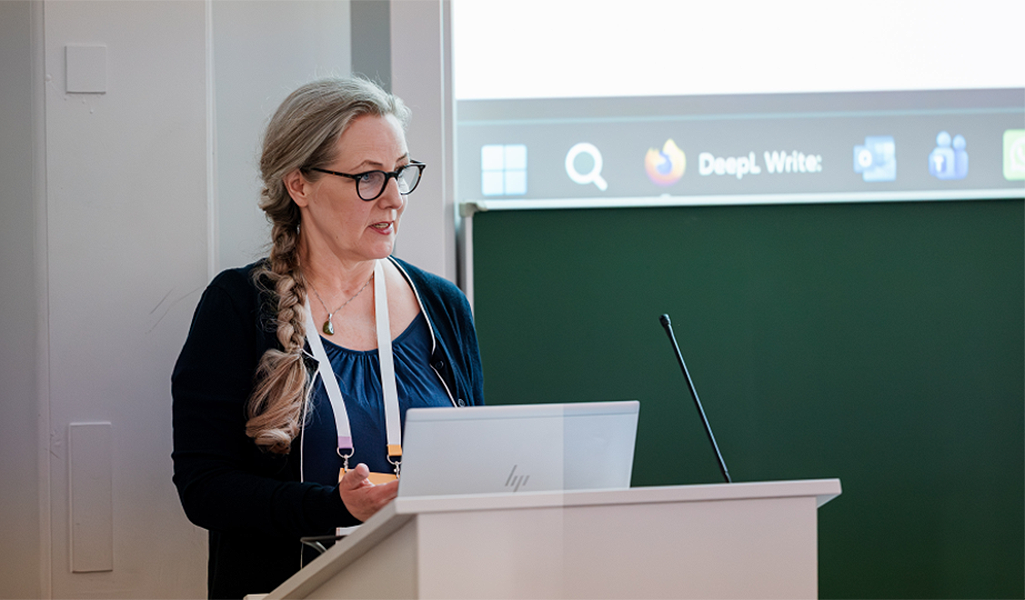
How can academic achievement be assessed reliably when generative AI can produce convincing academic texts? At DESRIST 2026 in Münster, Sylvana Kroop from the Department of Digital Economy at FHWien der WKW presented an initial, deliberately experimental approach to redesigning master’s theses.
Generative AI and large language models are fundamentally changing the conditions of academic work. This becomes particularly evident in the case of traditional Master’s theses. For decades, a comprehensive and linguistically polished written thesis was regarded as a central indicator of academic competence. In the age of AI, this assumption is becoming fragile. Academic-sounding text can now be produced, revised and formally perfected with limited independent cognitive effort.
This creates a deeper problem than the mere question of deception or plagiarism. It concerns the epistemic adequacy of the assessment format itself — in other words, the extent to which a Master’s thesis can still serve as meaningful evidence of academic achievement in the age of AI. If texts no longer reliably indicate what students have actually understood, decided, developed and evaluated, then the format of the Master’s thesis itself must be rethought.
Against this backdrop, Sylvana Kroop presented her Research-in-Progress paper titled “Redesigning the Master’s Thesis for Epistemic Adequacy Using Design Science Research in a Generative AI (LLM)–Supported Context” at the 21st International Conference on Design Science Research in Information Systems and Technology (DESRIST 2026). DESRIST is regarded as an international meeting point for the Design Science Research community, where researchers from Europe, North America, Australia and other regions come together each year to discuss new methodological, theoretical and practical developments in Design Science Research. In 2026, the conference took place at the Prince-Bishop’s Palace in Münster under the theme “Design for Better Futures. Beyond the Science of the Artificial.”
Overcoming Monolithic Master’s Theses Through Alternative Models
The contribution builds on established Design Science Research approaches and applies them to the question of how Master’s theses can be designed and assessed in an epistemically adequate way in the context of generative AI. Kroop emphasizes that the contribution does not present a finished master plan for “the future of the master’s thesis.” Rather, it uses the new Master’s programs in Digital Innovation and Digital Technology & Innovation as a space for experimenting with an alternative model. The aim is to gradually move beyond the traditional, monolithic Master’s thesis, which often comprises 80, 100, or more pages, toward a more process-oriented approach.
At the center of the model is a four-stage Master’s thesis process based on Design Science Research (DSR). Students do not primarily work toward one long final document. Instead, they move through four consecutive phases: problem space, knowledge base, research and development plan and valid digital artifact. The overall length of the written thesis is reduced to around 30 pages. This limitation is intended to enforce precision. The focus is no longer on text volume or stylistic polish, but on whether a relevant problem has been understood, theoretically and empirically grounded, methodologically addressed in a transparent way, and translated into a verifiable development and evaluation process.
The Artifact as a Process of Inquiry
The development of a digital artifact is not merely the expected result of the Master’s thesis, but also a central process of inquiry. Only through designing, implementing, testing, and refining does it become visible which assumptions are robust, which requirements are truly relevant, and whether the chosen solution can be effective in its specific context. The artifact is therefore not a trophy at the end of a theoretical phase, but the place where academic insight must prove itself in practice.
Initial experiences show considerable potential. Strict milestones, mandatory presentations and the “forward-only” principle make progress visible earlier and reduce the risk that major problems only emerge shortly before final submission. At the same time, the model is a starting point, not a finished ideal. Page limits, supervisory capacities, assessment rubrics, and support for Master’s thesis supervisors still need to be further developed. This is precisely where the value of the approach lies: it opens up a well-founded discussion on how universities can responsibly redesign academic qualification theses in the age of AI.
The contribution does not view generative AI merely as a disruption, but as an opportunity to revisit a long-overdue question: What is a Master’s thesis actually supposed to prove? If the answer can no longer be “as much well-written text as possible,” then process quality, methodological transparency, verifiable decisions, and the research and development of effective digital artifacts move to the center.
Study presentation and AI-generated English-language podcast on the DESRIST 2026 conference website
The Research-in-Progress paper was published in the DESRIST 2026 proceedings: Kroop, S. (2026). Redesigning the Master’s Thesis for Epistemic Adequacy Using Design Science Research in a Generative AI (LLM)–Supported Context. In: Chatterjee, S., Gregor, S., Kipping, G., Mansingh, G. (eds) Design for Better Futures: Beyond the Science of the Artificial. Prototypes and Research-in-Progress. DESRIST 2026. Lecture Notes in Computer Science, vol 16607. Springer, Cham. https://doi.org/10.1007/978-3-032-28570-6_19