Isabel Rodenas and Patrick Rupprecht from the Institute for Digital Transformation & Strategy (IDS) investigated the impact of different role distributions in the design thinking process on efficiency, workload and human control. They presented their findings at the 18th International Conference on Human Interaction and Emerging Technologies 2026 in Venice.
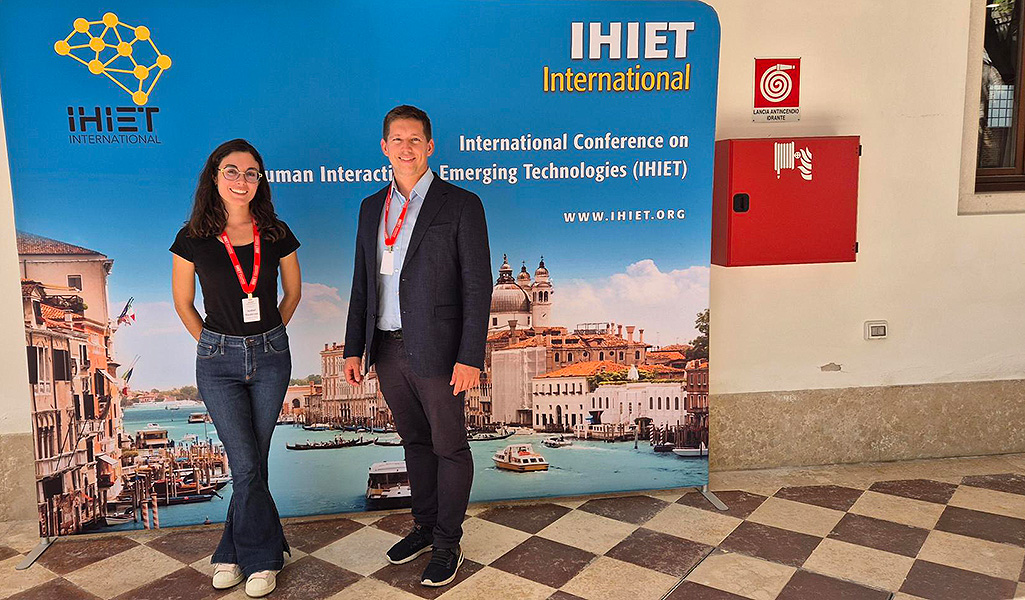
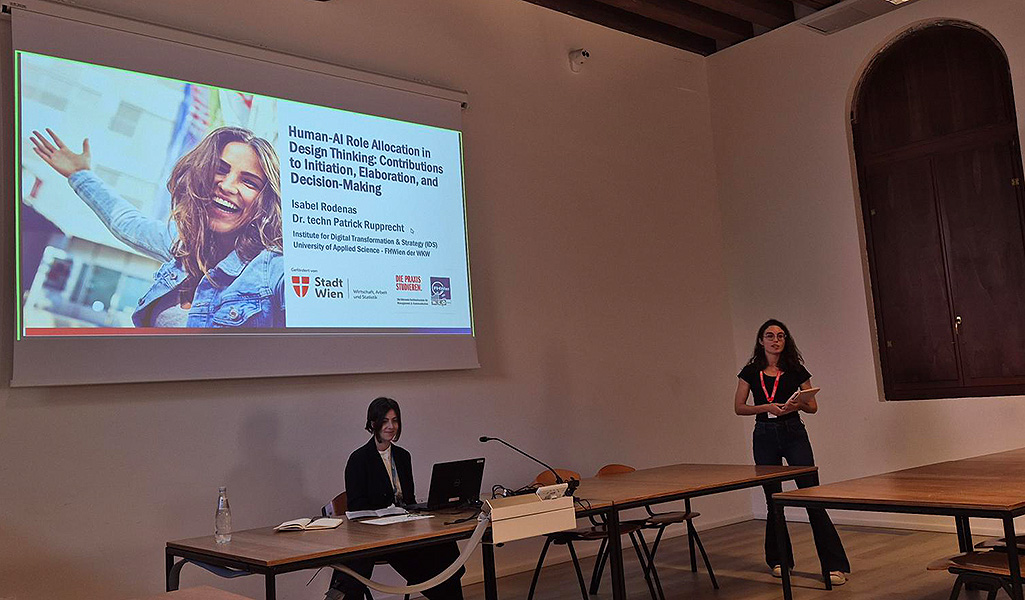
Generative AI can accelerate innovation processes and reduce cognitive load. At the same time, an overly dominant role played by AI can undermine the sense of human control. Isabel Rodenas and Patrick Rupprecht examined this tension in their paper “Human-AI Role Allocation in Design Thinking: Contributions to Initiation, Elaboration and Decision-Making”, which they presented at IHIET 2026.
Experimental Human-AI Collaboration
In an experimental setup, working professionals in teams of two collaborated with ChatGPT on a 60-minute design thinking task. Two forms of collaboration were compared. In the AI–Human–AI sequence, the AI initially provided the first results. The participants discussed and refined these ideas before the AI created a final version or a shortlist. In the human–AI–human sequence, the humans first developed their own ideas, which were then expanded upon and structured by the AI. Here, the final decision remained with the participants.
The results reveal a trade-off between efficiency and human control. The AI–Human–AI group found the collaboration to be more user-friendly and reported that the workload was lighter. At the same time, some participants expressed concerns about the AI playing too dominant a role. In the Human–AI–Human group, human control remained more pronounced, though this required greater effort in development, evaluation and revision.
The Added Value of AI as a Structuring and Supportive Assistant
The study concludes that generative AI creates added value particularly as a structuring and supportive assistant, for example in idea generation, elaboration, reformulation and preliminary evaluation. However, the final decision-making responsibility should remain with humans. For SMEs, therefore, it is not only important which AI is used, but also when and in what role it is integrated into the innovation process.
The presented conference paper was created as part of the “HybrAId” project, which was funded by the City of Vienna (MA 23). Further information on “Hybrid Intelligence in SMEs” can be found on the “HybrAId” project page.