Since fall 2021, the Research Institute IDS at FHWien der WKW and the startup BOOXit have been collaborating on solutions for more sustainable, digitized, and human-centered logistics.
From a prototype of a reusable box to digitally connected logistics systems: For five years, the Institute for Digital Transformation and Strategy (IDS) at FHWien der WKW has been collaborating with the Upper Austrian startup BOOXit. In four joint research projects – three of which have already been completed – the potential applications of smart reusable containers in pharmaceutical, parcel, and military logistics were investigated. This research is continuing through the SIBORC project, which runs until 2027, and the HumAInLog competence team, launched in 2026.
“Since the IDS was founded, we’ve consistently had at least one joint project with BOOXit,” recalls Walter Mayrhofer, head of the IDS.
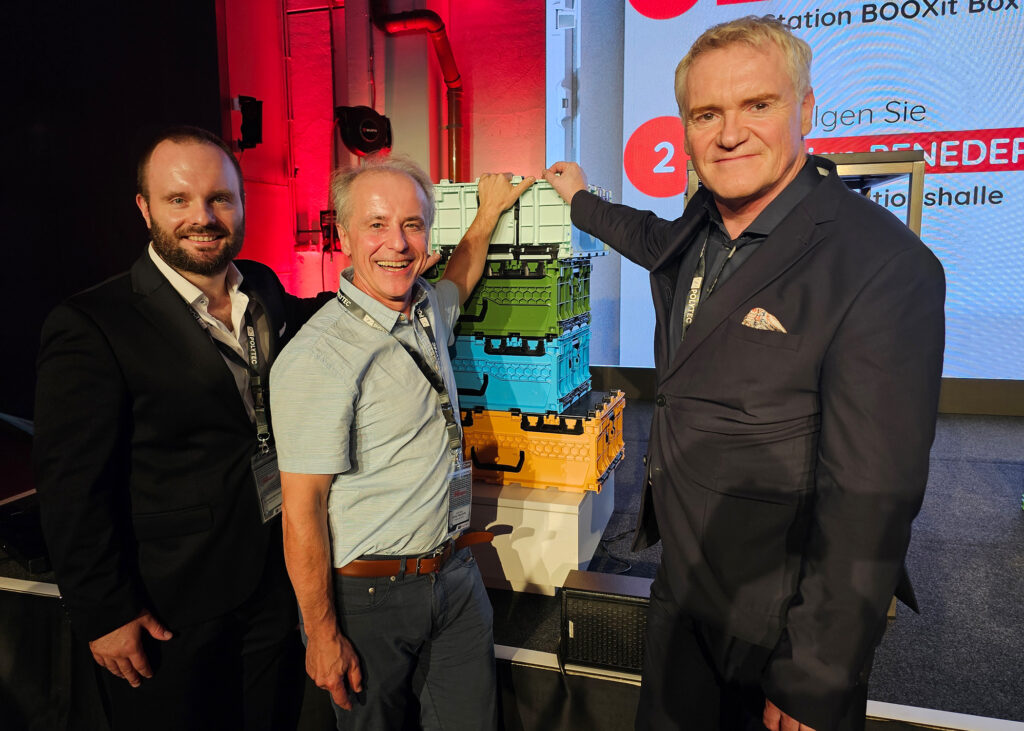
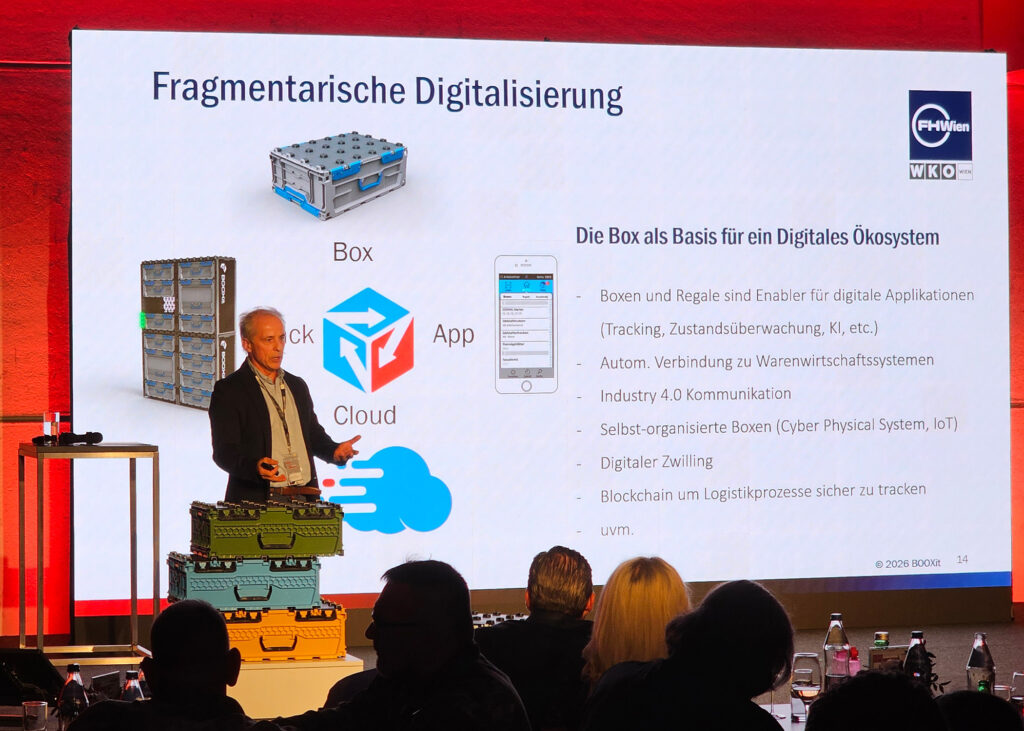
During his keynote speech at the product presentation of smart reusable logistics boxes on September 8, 2026, in Ebensee, Upper Austria, he reflected on the progress made.
“The projects demonstrate how reusable systems can reduce packaging waste while simultaneously enabling digitalization, automation, and better working conditions.”
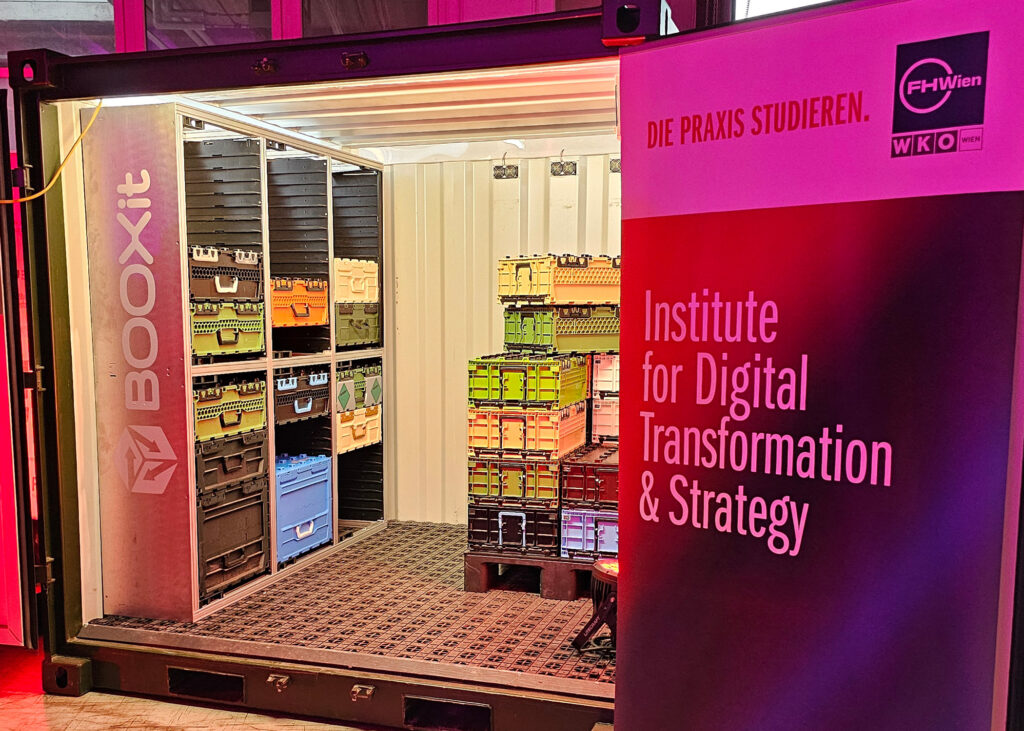
The new generation of BOOXit reusable containers, the corresponding digital logistics system, and the industrial production line for the reusable boxes were presented in the POLYTEC GROUP’s manufacturing facilities.
From Pharmaceutical Logistics to a Smart Reusable System
The collaboration began in 2021 with the DigiPharmaLogNet project, coordinated by FHWien der WKW. At that time, aside from numerous animations illustrating the BOOXit concept, there was only a single 3D-printed prototype of the BOOXit box. The project, funded by the Austrian Research Promotion Agency (FFG), investigated how self-organizing reusable boxes and corresponding shelving systems could be used in pharmaceutical logistics. Sensors were used to track location, temperature, and further transport conditions, among other things. The IDS analyzed the processes as well as their economic, environmental, and social impacts and developed approaches for viable business models.
Saving Time and Money
Calculations for the delivery process between pharmaceutical wholesalers and pharmacies revealed significant potential for optimization: With over 20,000 delivery runs per year, approximately 1.37 million euros could be saved annually. Switching to a closed-loop reusable container system would shorten the tours – which currently take between three and eight hours – by an average of about 1.25 hours. In the scenarios examined, based on specific use cases from the daily transportation practices of pharmaceutical companies, the break-even point would be reached after approximately one year. Furthermore, the results demonstrated the importance of closed-loop systems and a reliable return process for the containers.
Starting 2022, the follow-up project ReKEP (led by AIT Austrian Institute of Technology GmbH) applied this approach to the courier, express, and parcel industry. The focus was on economic, environmental, and social sustainability, as well as on how return processes for reusable containers should be designed. It became clear that reusable systems work particularly well in simple, closed-loop systems. Here, too, it became clear that reliable return of the reusable containers and low loss rates are necessary for the system to be implemented on a larger scale. This would be ensured primarily through electronic tracking capabilities to monitor the return of the boxes, as well as by promoting customer acceptance of the containers.
New Applications and Better Working Conditions
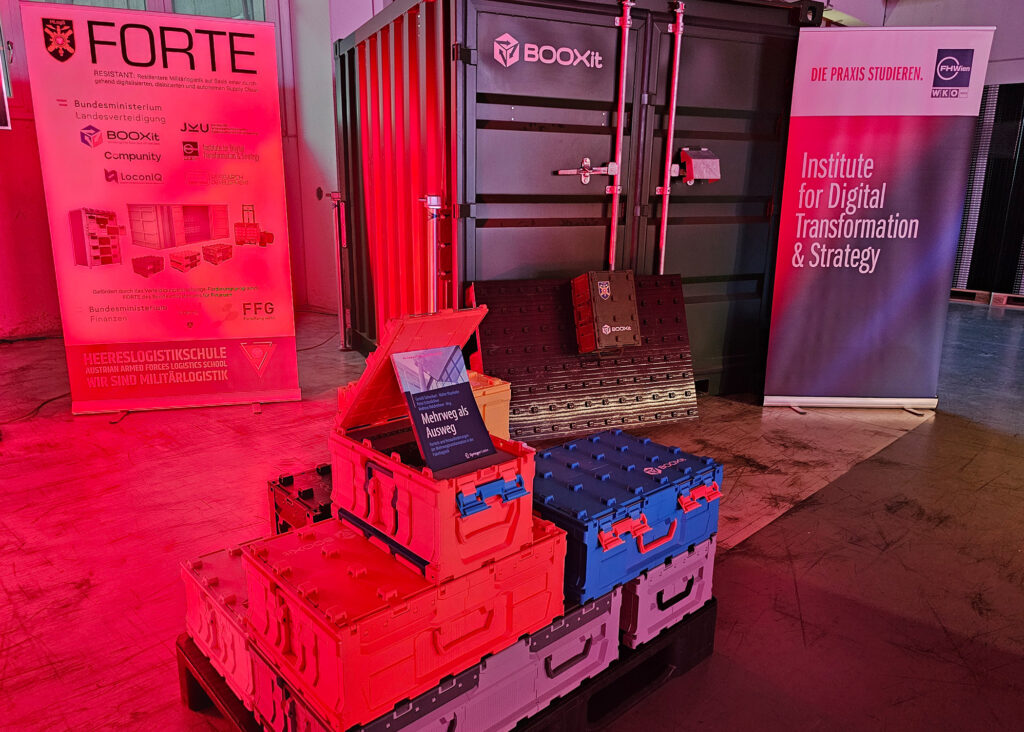
In the RESISTANT project (consortium leader: Johannes Kepler University Linz), the concept was applied to military logistics. With the help of digitally networked, decentralized, and mobile storage units, supply chains were intended to become more resilient and transparent, even under difficult conditions.
Since November 2024, the SIBORC project (consortium leader: Fraunhofer Austria, KI4LIFE) has been investigating how complex reusable cycles can be simulated and optimized using digital twins and artificial intelligence. The IDS is assessing the impact of the developed solutions on people, organizations, the environment, and the economy. For example, a simulation of warehouse processes already conducted as part of the ReKEP project showed that a system based on BOOXit racks could reduce walking distances from 3,845 to 335 meters and significantly lower the ergonomic strain on employees.
Applied Science for Practical Implementation
“It is exciting to observe the development of the reusable box as part of this collaboration and to provide scientific support for the ongoing expansion of the BOOXit system,” says Gerald Schneikart, project manager and senior researcher at IDS. “The next important step is testing under real-world conditions. We look forward to supporting this pilot phase with our research in the future as well.”
For BOOXit CEO Peter Entenfellner, “the collaboration with FHWien der WKW across multiple research projects is characterized by a deep understanding of this disruptive logistics technology. The research team led by Walter Mayrhofer and Gerald Schneikart took the capabilities of our system and the practical challenges of logistics processes under challenging external conditions and, in a very pragmatic and solution-oriented manner, translated them into research results that can be applied in practice.”
Human focus in the further development of digital logistics technologies
In particular, the findings from the past five years regarding ergonomic workloads are benefiting the HumAInLog competence team, which was launched in June 2026. Funded by the City of Vienna, this IDS project is researching human-centered technologies and AI assistance systems for delivery and transportation logistics. Here, the IDS’s collaboration with BOOXit finds a direct continuation in the form of a practical partnership. Overall, the collaboration to date – which has also involved numerous other academic and industry project partners – has been a key component of the research on the use of digital technologies in the context of logistics at FHWien der WKW.