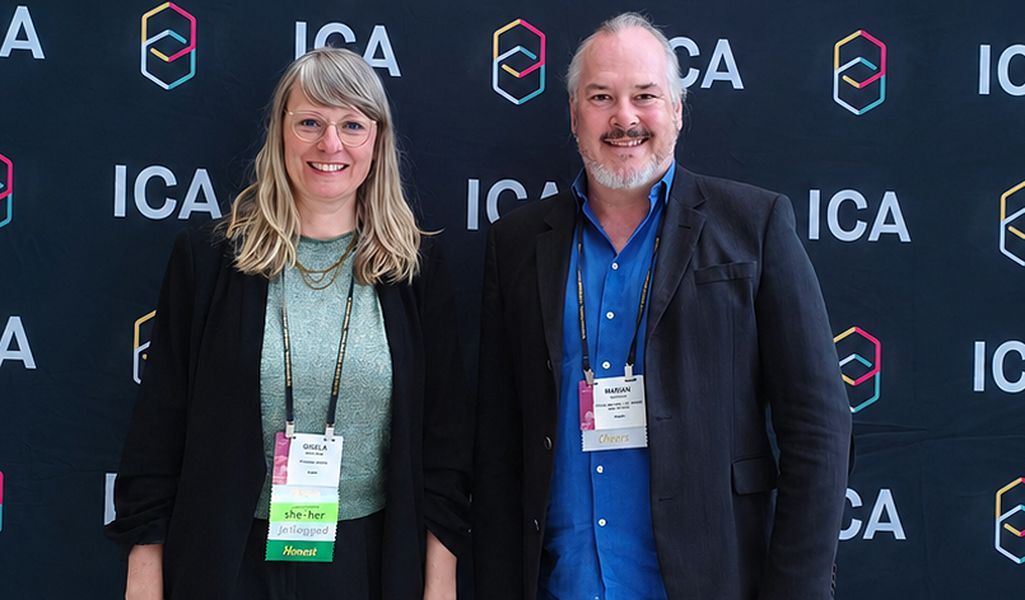
How do the media report on war, and what makes such reports credible? Gisela Reiter and Marian Adolf from the Department of Communication at FHWien der WKW explored these questions. They presented their findings at the 76th Annual Conference of the International Communication Association (ICA) in Cape Town, South Africa.
War reporting takes place under extraordinary conditions. Not only the content but also the form of reporting shapes how credible information is perceived. What images are shown? Which sources are disclosed? How can information be conveyed without violating the dignity and privacy of those affected? And how do users experience the media’s portrayal of war?
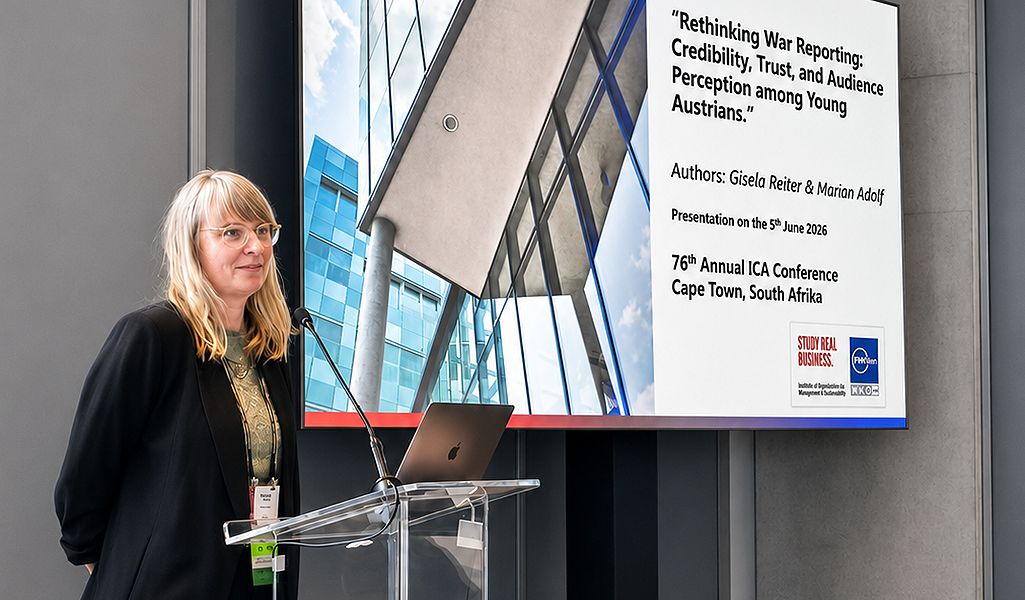
Gisela Reiter and Marian Adolf addressed these questions in their presentation “Rethinking War Reporting: Credibility, Trust, and Audience Perception among Young Austrians”. The researchers presented their findings at the largest international conference for communication research, the 76th Annual Conference of the International Communication Association (ICA), which took place from June 4 to 8, 2026, in Cape Town, South Africa, under the theme “Communication and Inequalities in Context”.
Research on the Credibility of War Reporting
The study focuses on reporting on the war in Ukraine, which serves as an example of journalistic work under particularly difficult conditions. Propaganda, uncertain casualty figures, and limited access to the scenes of conflict make it difficult to verify information. At the same time, the abundance of images and videos on social media platforms makes it increasingly difficult for the public to make sense of events.
The study shows that trust in war reporting arises primarily where information is perceived as balanced, transparent, and comprehensible. Established media brands also play an important role in assessing credibility. Young people in particular experience constant exposure to negative news as stressful and overwhelming.
Transparency and Context as the Foundation of Credibility
Another finding concerns the tension between professional journalism and personal social media accounts. Journalists are often perceived as more reliable because they adhere to professional standards. However, respondents are generally unclear about these requirements for journalists and how they operate. In addition, personal footage from war zones often conveys a sense of closeness and immediacy.
The study concludes: Good war reporting is far more than the rapid dissemination of information. It requires a delicate balancing act between proximity and distance, emotionality and context, as well as the education and protection of those affected.