How can a sealed-off high-security camp at the EU’s external borders be made audible? As part of Radio Radieschen’s event series “Abend im Hörfeld,” Anja Troelenberg offered insights into the Ö1 series Border Business, which she created together with Franziska Grillmeier.
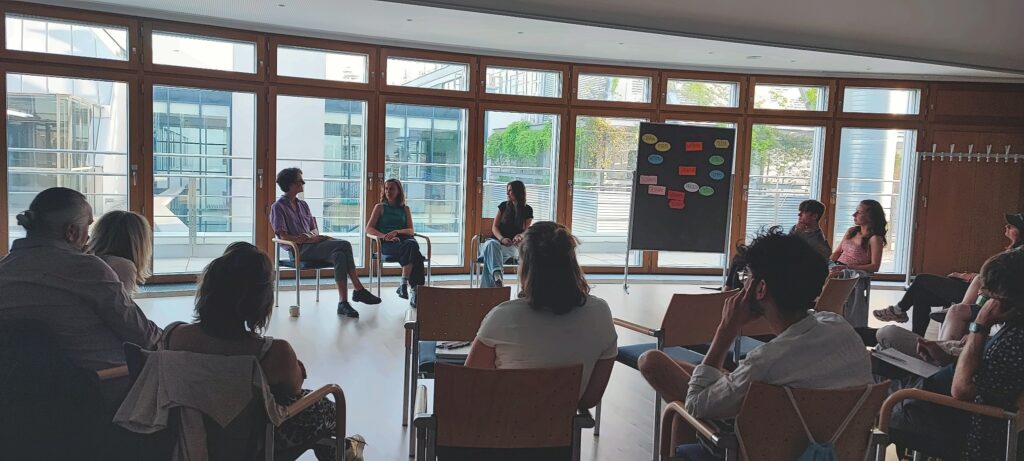
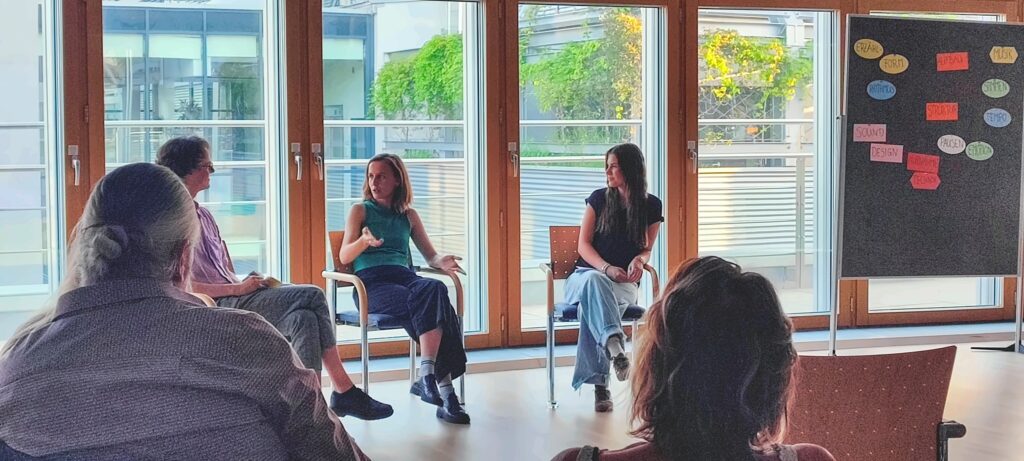
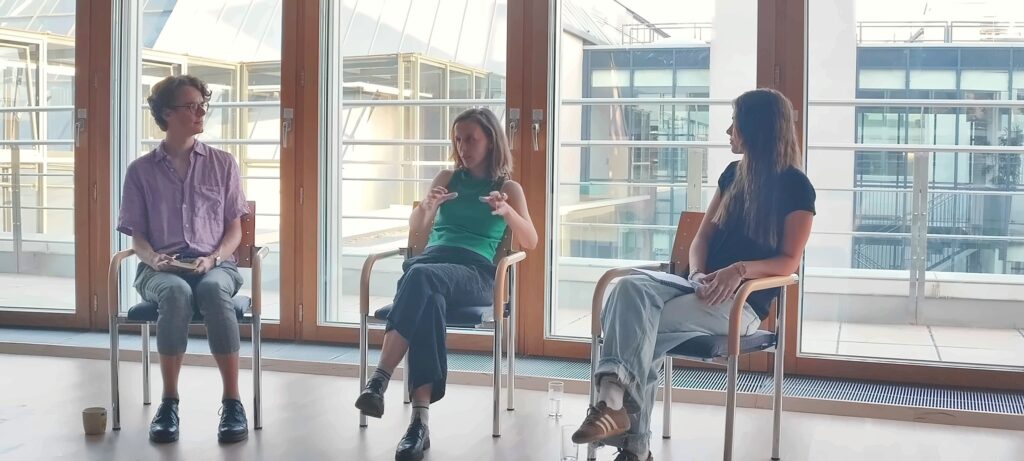
At the ballroom C517, journalist Anja Troelenberg spoke about how places that are barely accessible and complex political systems can be explored through audio storytelling. The evening was moderated by Vincent Leb and Franziska Fries.
Border Business: Reporting from Samos
Together with Franziska Grillmeier, Troelenberg produced the Ö1 series Border Business – The Business of Europe’s Borders. The focus of the evening was the third episode, The Technology: Scene Greece (3), which takes listeners to the island of Samos. In 2021, one of the first “Closed Controlled Access Centers” (CCACs) was opened there – a high-security camp funded by the EU and regarded as a pilot project for Europe’s external borders.
Surveillance, Control and Fundamental Rights
The episode shows how the “Hyperion” access system controls entries and exits using electronic cards containing biometric data, while “Centaur” monitors the site with the help of AI-supported cameras, drones and sensors. The investigation reveals how strongly security logics and technological control shape European migration policy, while also raising questions about transparency and fundamental rights. Despite a record fine imposed by the Greek data protection authority in 2024 due to serious shortcomings, the camps continue to be expanded. Access, however, remains highly restricted – including, and especially, for journalists.
Working Under Difficult Conditions
In the discussion, Troelenberg offered insights into the realities of this kind of reporting. Many of the places featured in the series, such as high-security camps and return centres, were barely accessible. The team had to improvise in order to capture voices on the ground – for example by conducting conversations at the nearest kiosk when access to a camp was denied. The narrative gradually developed from the material itself: Which scenes and sounds stay with you? Which perspectives carry the story?
Intuitive Storytelling, Restrained Tone
Troelenberg described her approach as intuitive: interviews, atmospheres and striking sounds are collected until a rhythm begins to emerge. Rather than relying on dramatization, the series places the system itself at the centre – the political decisions, economic interests and technological infrastructures behind Europe’s border regime. Personal stories are present, but they are not the main focus.
Conclusion
Once again, Abend im Hörfeld made tangible the power of listening to stories together and showed how inspiring exchange among audio creators can be. The event benefits not only the aspiring journalists in the Journalism & Media Management study area, but also everyone interested in gaining insights into investigative research methods and exchanging ideas about contemporary storytelling.