From 29 June to 3 July 2026, the International School of Multimedia Journalism (ISMJ) continued this year’s programme in Warsaw. Following the first project week at FHWien der WKW in February, journalism students from Austria, Denmark, and Ukraine once again worked together in international teams. Under the theme “Reporting Wars: From the Frontline to the Timeline,” they explored the challenges of war and crisis reporting in the digital age.
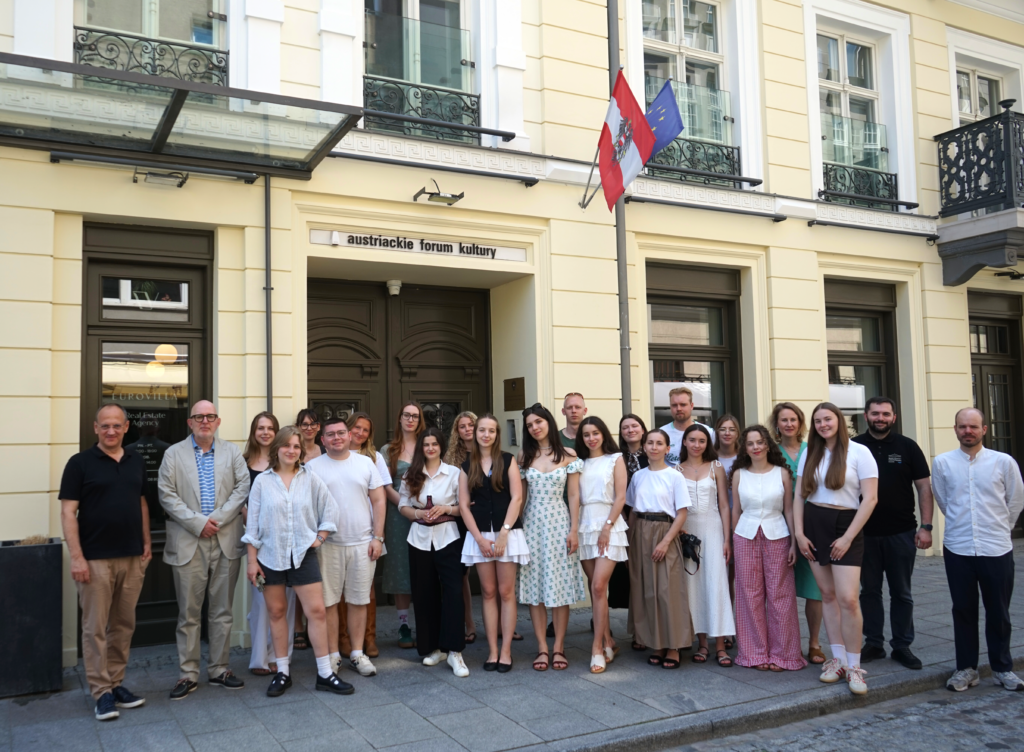
The project week began with initial group work sessions and a welcome dinner at the Austrian Cultural Forum Warsaw. Over the following days, the teams continued working on their projects at the SGH Warsaw School of Economics.
During the second project week, the students produced four multimedia features exploring topics such as journalistic ethics, media narratives, disinformation, and the representation of refugees. Throughout the week, they were supported by renowned journalists and media professionals.
The project was complemented by a lecture from Polish journalist Maciej Zakrocki. In his presentation “Europe Is Forged in Crises” he shared insights into political reporting on Central and Eastern Europe and discussed the challenges currently facing journalism in the region.
“The ISMJ combines international collaboration with hands-on journalistic practice,” said Daniela Süssenbacher, Head of the Journalism & Media Management Study Programs at FHWien der WKW. “Within a very short period of time, students are required to verify information, weigh different perspectives, and produce original multimedia stories. These are precisely the skills that are essential for responsible war and crisis reporting.”
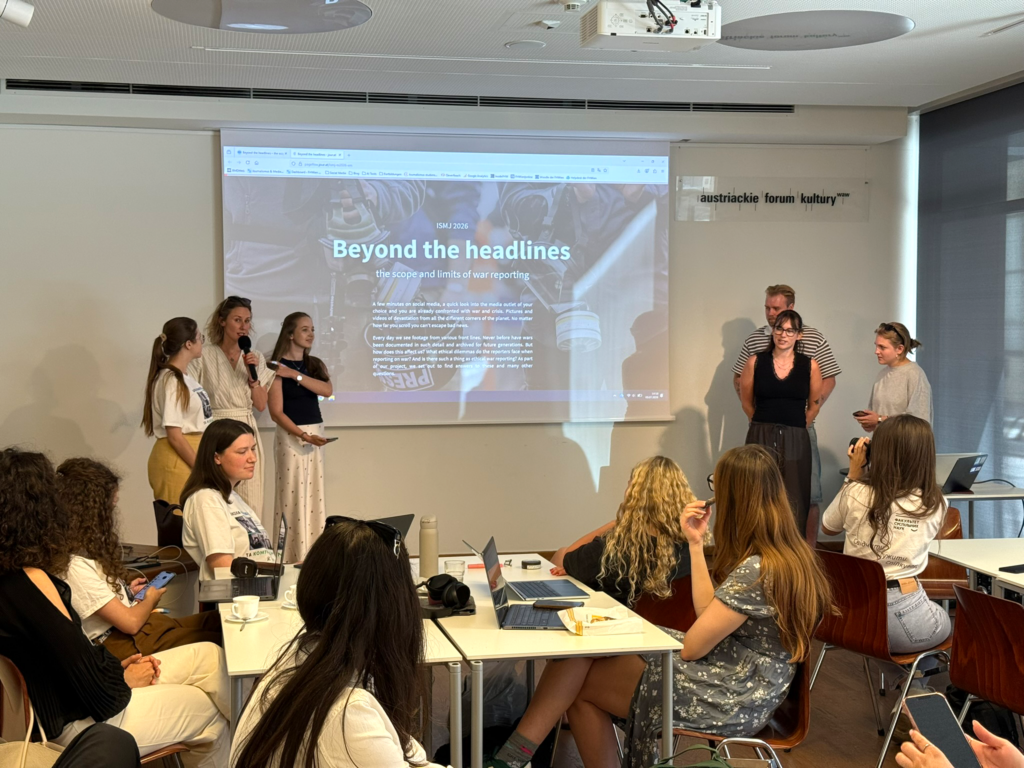
The project week concluded with the final presentations at the Austrian Cultural Forum Warsaw. There, the four international teams presented their multimedia features, sharing insights into their research, editorial decision-making and production process.
Across the two project weeks in Vienna and Warsaw, the International School of Multimedia Journalism once again gave participants the opportunity to experience international collaboration and journalistic practice under real-world conditions. Working in intercultural teams, the students engaged intensively with the challenges of war and crisis reporting.
At the same time, they produced a diverse range of multimedia features that demonstrate the wide variety of journalistic perspectives on war and the media. In doing so, the ISMJ once again contributed to educating a new generation of responsible journalists in 2026.
The Four Multimedia Features at a Glance
|
“Framing the Frontline: Ukraine Coverage Across Denmark, Germany, and Poland” compares media coverage of Russia’s war against Ukraine in Denmark, Germany, and Poland. The team interviewed journalists from across Europe to explore how media attention has evolved over time, which narratives dominate coverage, and which stories continue to receive too little attention. Multimedia feature from: Anna Pedersen, Valentina Perner, Marta Stetsko and Andriiana Ilkiv. |
|
“Beyond the Headlines – the Scope and Limits of War Reporting” explores the ethical challenges of war and crisis reporting. It focuses on the limits of what should be shown and on how constant exposure to war-related news affects audiences. For the feature, the team interviewed media experts, journalists, and people directly affected by war. Multimedia feature from: Aviana Horvath, Elsa Mayringer, Solomiia Bodnarchuk, Sofiia Dubik and Marcus Norup Refsgaard. |
|
“ Whose ●RECponsibility: Images of Ukrainian Women Refugees in Polish Media” examines how Ukrainian women refugees are portrayed in the Polish media and perceived by the local population in Warsaw. To explore these perspectives, the team interviewed both Ukrainian women living in Poland and residents of Warsaw. Multimedia feature from: Zoriana Katola, Renja Natalia Prechtl, Solomiia Stanovych, Signe Nielsen and Christoph Bosnjak |
|
“Breathing the Air of War – Telling Stories of the War in Ukraine through Art” explores the role of art in reflecting on and communicating the realities of war. Through visits to exhibitions in Warsaw and interviews with experts, the team examined whether art can foster empathy and understanding while offering perspectives that go beyond facts, headlines, and conventional news reporting. Multimedia feature from: Gustav S. Frisch, Iwan Kasprzyk, Yuliia Musianovych, Oleksandra Zharska and Tamila Koval. |

About the International School of Multimedia JournalismThe ISMJ was established after the annexation of Crimea and the start of the Russian-Ukrainian war in 2014. The project is a collaboration between the Journalism & Media Management study programs at FHWien der WKW, the Ukrainian Catholic University of Lviv and the OeAD Cooperation Office in Lviv. It`s aim is to strengthen the connection between the two countries and send a signal of support for Ukraine. Since the second year of its existence, the Danish School of Media and Journalism and the Georgian Institute of Public Affairs have also participated as additional project partners.
The project is being carried out with financial support from the Austrian Federal Ministry of Women, Science and Research and is being realised in cooperation with the Ukranian Catholic University, the Ukraine Office Austria and the Austrian Cultural Forum in Warsaw. Further information about the ISMJ can be found on the project website at https://multimediajournalism.eu/. |