Rethinking caring democracy, inclusive cities and ageing societies in interdisciplinary dialogue
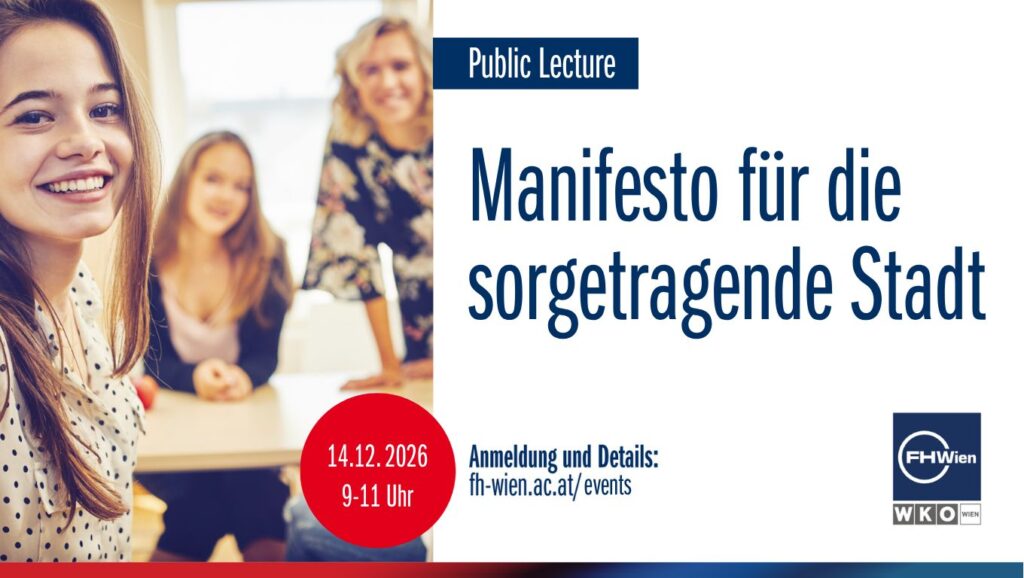
Cities are held together by care. Every day, people provide for, teach, heal, clean, repair, accompany, listen to and look after one another – and the infrastructures and neighbourhoods they share. Yet this work remains largely invisible, feminised, privatised and undervalued.
Framing care as a private responsibility rather than a shared social obligation has left our societies vulnerable – a vulnerability now intensified by demographic change, the climate crisis, the housing shortage and the commercialisation of urban space.
The “Manifesto for a Caring City” invites us to think together: How can we make our cities more inclusive – and which resources can we draw on along the way? Impulse talks from research and practice open up an interdisciplinary dialogue in which we will collectively develop approaches to the challenges facing contemporary society and our cities.
Impulse talks:
- Emma Dowling, Department of Sociology, University of Vienna
- Anna Wanka, Department of Sociology, University of Vienna
- Cornelia Dlabaja, FHWien der WKW
- Jan Sifra, Büro Milk
Discussants:
- Michaela Moser, Die Armutskonferenz (Austrian Poverty Conference)
- Julia Giradi-Hoog., City of Vienna
- Representative from Rooming In
- Representative from Die Grätzlerei
This public lecture will be held in German.
Note: Your personal data will be processed exclusively in accordance with the provisions of the European Data Protection Regulation (DSGVO) and the Austrian data protection regulations, in particular the Austrian Data Protection Act (DSG). Privacy at the FHWien der WKW.
In the course of this event, photos/videos/sound recordings may be made by or on behalf of FHWien der WKW. By participating in the event, you acknowledge that photos, video materials and/or sound recordings may be used for reporting purposes and published in a wide variety of (social) media, publications and on FHWien der WKW websites. These recordings may be associated with the pictorial representation of persons present, whereby the selection of persons is random.